AI’s Dual Path: Workforce Impact in European vs. US Banking
Why Europe’s Workforce Faces Slower AI Shifts
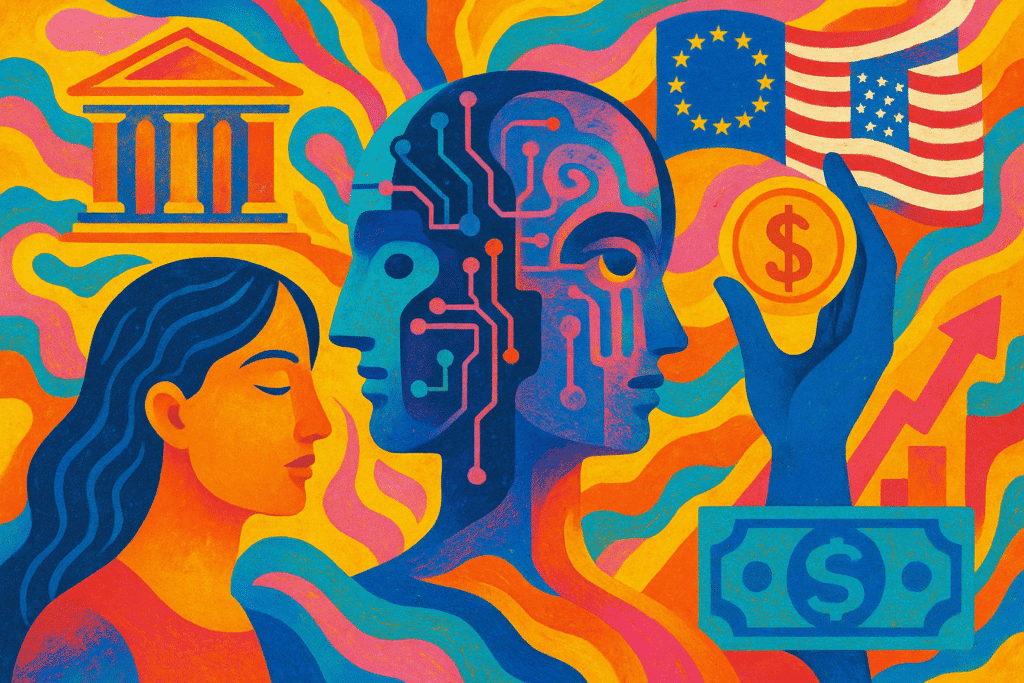
Morningstar DBRS reports that European banks will see slower AI-driven job attrition than US banks. Several mechanisms explain this. Stronger employment protections and collective bargaining lengthen decision timelines for redundancies and reassignments. Co-operative and mutual bank models add governance layers that prioritise job preservation and phased change. An older average workforce raises the cost and complexity of large-scale redeployment. Together these factors produce a more gradual transition from human roles to automated processes.
The US Model: Faster AI Integration, Faster Job Redefinition
US banks typically operate with more flexible hiring and firing norms, enabling rapid restructuring when AI can replace repetitive functions. Venture-backed fintech and large tech partnerships accelerate deployment of automation and analytics. The result is quicker headcount realignment, larger immediate cost reductions, and greater short term disruption to existing roles. That velocity can boost competitiveness but risks skills gaps and morale issues if retraining lags.
Beyond Layoffs: Strategic Implications for Banks
Workforce change is not binary. Both regions will see role transformation as AI handles routine tasks and employees move toward oversight, customer advisory, model validation and product design. European banks may focus more on staged reskilling programs and job-sharing models. US institutions may prioritise rapid talent redeployment and strategic hiring for AI-native skills. In both cases, governance, data strategy, and learning pathways will determine how well AI lifts productivity without creating operational risk.
The Financial Edge: Cost Savings and Competitive Positioning
Slower attrition in Europe reduces short-term layoffs and the immediate payroll savings that US banks can capture. However, gradual change can protect customer relationships and institutional knowledge. Faster US adoption can deliver larger near-term cost savings but may incur higher transition costs and reputational risk. For executives, the choice is between speed with heavy reinvestment in new skills or paced transformation that preserves continuity.
Bottom line: AI will reshape banking workforces in both markets. The policy and ownership frameworks in Europe act as buffers, while US market incentives push for rapid change. Executives should align AI roadmaps with labour realities and a clear plan for reskilling to convert disruption into sustained advantage.