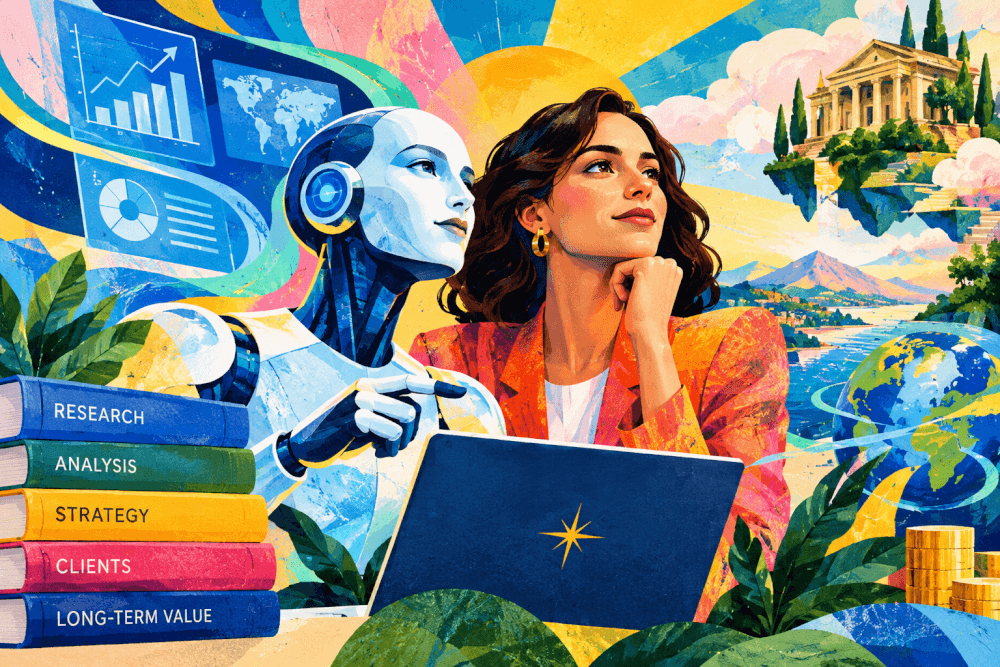
Private banks are applying artificial intelligence across research, operations and client reporting to accelerate workflows and free investment teams from repetitive tasks. Leading firms such as UBS, Citi, JPMorgan, HSBC, Edmond de Rothschild, Northern Trust and BNP Paribas use AI for faster data synthesis, scenario analysis and tailored client briefs. Yet human judgment remains the final arbiter.
AI’s Dual Impact: Efficiency and Strategic Challenges
AI delivers tangible productivity gains: automated earnings summaries, quick stress tests of asset allocations, and personalised reporting at scale. That reduces “no joy work” and allows senior analysts and CIOs to focus on portfolio themes and risk oversight. At the same time AI models draw on historical patterns. That limits their ability to foresee regime shifts and can produce unchecked outputs or “AI slop” if models lack robust validation. Critical questioning, model skepticism and contextual interpretation are still required to translate machine output into investment action.
Evolving Roles and The Competitive Imperative
Teams are shifting from deep siloed specialists to professionals who combine sector knowledge with data literacy and cross-asset perspective. Skills that rise in importance include scenario design, forensic model review, and the ability to tell a clear investment narrative to clients. Banks that adopt AI thoughtfully gain faster response times and operational scale, but AI alone has not proven to reliably deliver superior long-term returns. Data governance, access controls and audit trails are non-negotiable: clients and regulators demand clarity on inputs, limitations and accountability.
For CIOs and investment leaders the practical path is hybrid: deploy AI to shorten research cycles and automate routine tasks while preserving human oversight for strategy, judgment and client trust. Competitive advantage will come from combining technical tooling with disciplined governance and a workforce able to question model outputs, not just accept them.