
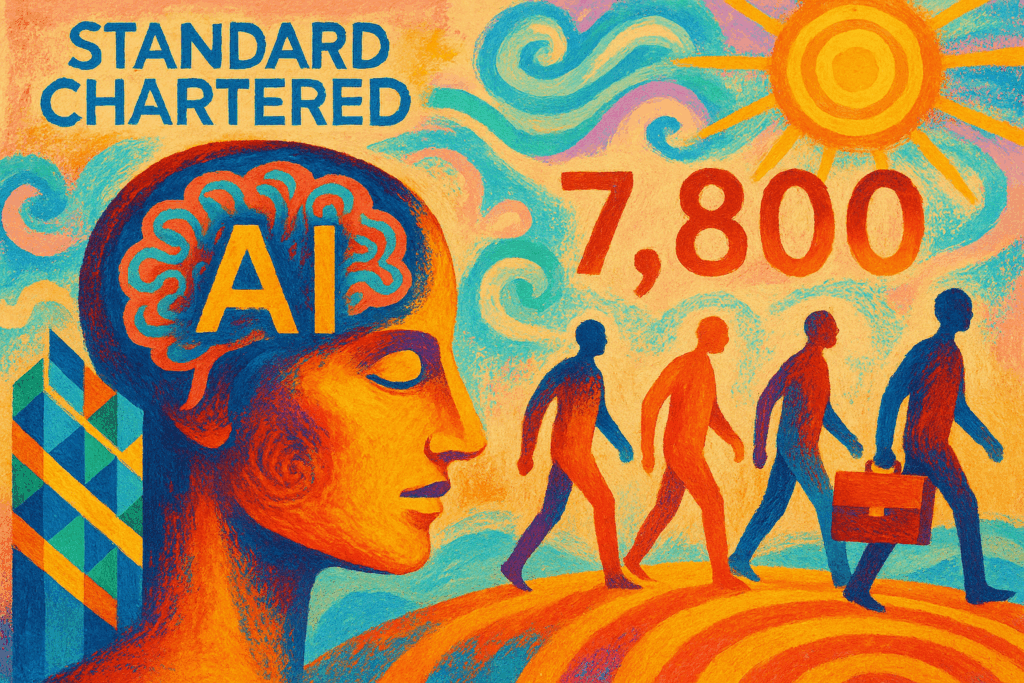
Standard Chartered has announced plans to reduce roughly 15% of certain roles, around 7,800 positions, by 2030 as it scales artificial intelligence across its operations. The bank said in a statement it is “scaling practical uses of AI across the bank to simplify processes and improve decision making,” pointing to a strategic shift from manual processing to automation in key back-office hubs such as India, China, Malaysia and Poland.
AI’s Impact on Back-Office Operations
The cuts target repeatable operational tasks that AI and automation handle well: data entry, reconciliations, transaction monitoring, document processing and parts of onboarding and compliance workflows. By replacing manual steps with models and rules-based automation, banks expect faster processing times, fewer human errors and lower ongoing operating costs. Short term, banks face one-time restructuring costs and transition risk. Over the medium term, efficiency gains can support higher margins if implementation and oversight are effective.
A Broader Industry Shift Towards Automation
Standard Chartered is not an outlier. Regional peers such as DBS and global financial institutions are reallocating roles as fintech and cloud providers introduce scalable automation tools. For investors and executives, this signals a sector-level move: cost bases will change, revenue models remain intact, and competitive advantage will depend on execution speed and governance.
For employees, demand will shift from routine processing to roles in model governance, data engineering, AI operations, risk management and digital product development. Firms that invest in targeted reskilling and strong model risk frameworks reduce implementation risk and regulatory exposure.
Bottom line: Standard Chartered’s plan is a clear indicator that banks are treating AI as an operational lever to lower costs and sharpen decision making. Watch for execution milestones, disclosure on savings timelines, and how banks manage the human and regulatory dimensions of this transition.